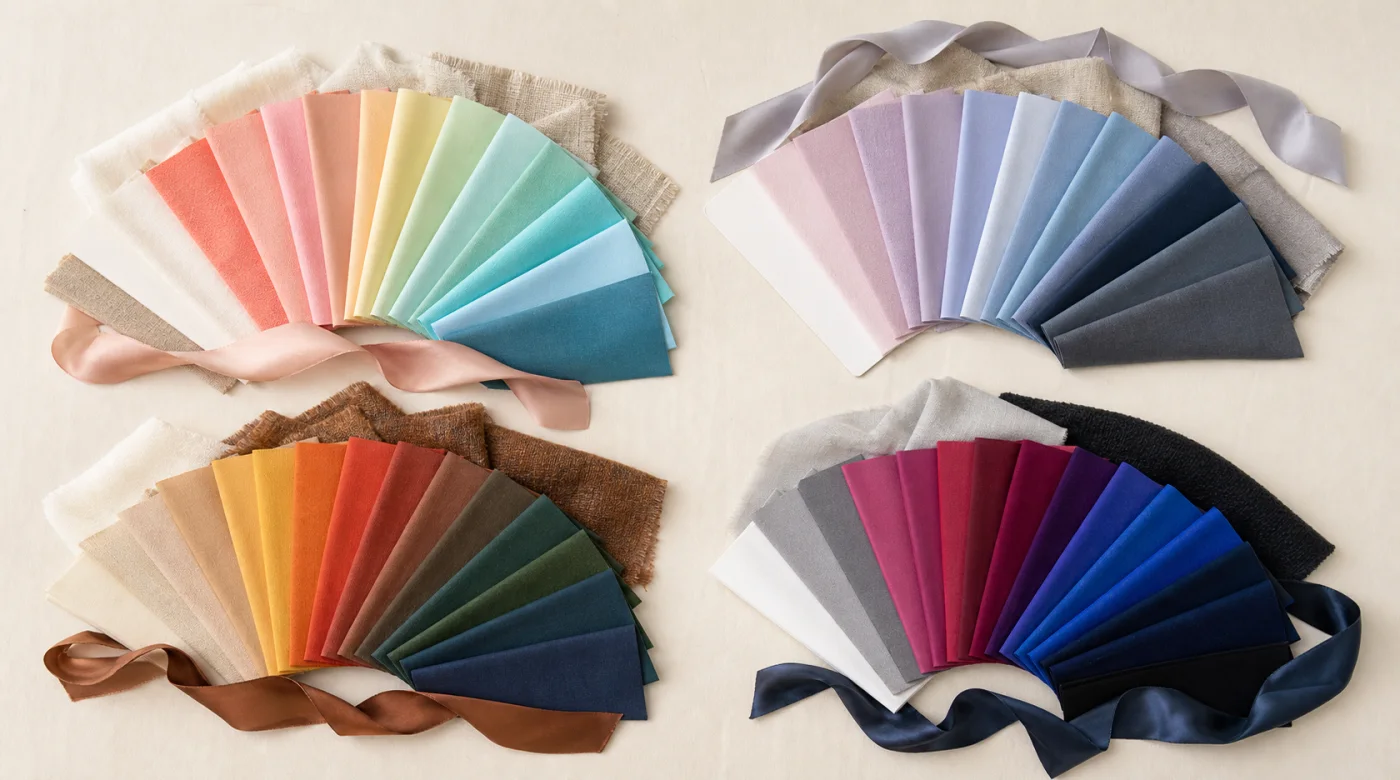
The four broad families
The familiar names Spring, Summer, Autumn, and Winter organize palettes by recurring combinations of color qualities. In a common 12-season framework, Spring is generally warmer and clearer, Summer cooler and softer, Autumn warmer and softer, and Winter cooler and clearer. These are broad styling patterns, not statements about a person’s age, ethnicity, or personality.
Each family contains variation because few people are defined by one quality alone. Light, deep, bright, soft, warm, and cool subseasons describe which dimension has the strongest influence within that family. For the underlying vocabulary, read the four dimensions of color analysis.
- Spring: Light, Warm, Bright
- Summer: Light, Cool, Soft
- Autumn: Soft, Warm, Deep
- Winter: Deep, Cool, Bright
Why neighboring seasons overlap
A Light Spring palette and a Light Summer palette share lightness even though their temperature direction differs. Soft Summer and Soft Autumn share muted chroma. Deep Autumn and Deep Winter both hold depth. That overlap is expected and useful: an individual may borrow successfully from a neighboring palette when the shared dimension matters more than the difference.
A result near a boundary can also vary with the photograph, lighting, hair color, makeup, and the set of comparisons used. The most stable information may be “soft and medium” rather than one exact season name.
Use the map as navigation
Begin with your strongest dimension, then refine. Someone whose result is Soft Summer might first avoid extreme chroma, compare cool and neutral-muted colors, and only later decide how closely to follow the full seasonal palette.
The map is most valuable when it reduces search space. It offers a manageable group of colors to try while leaving the final judgment to real garments, real lighting, and personal preference.
- Your season is a starting region, not a border patrol.
- Shared qualities explain why neighboring palettes can both work.
- A favorite outside-palette color does not invalidate an analysis.
Find your place on the 12-season map
Explore your season, compare neighboring palettes, and save the colors that work for you in Chroma.