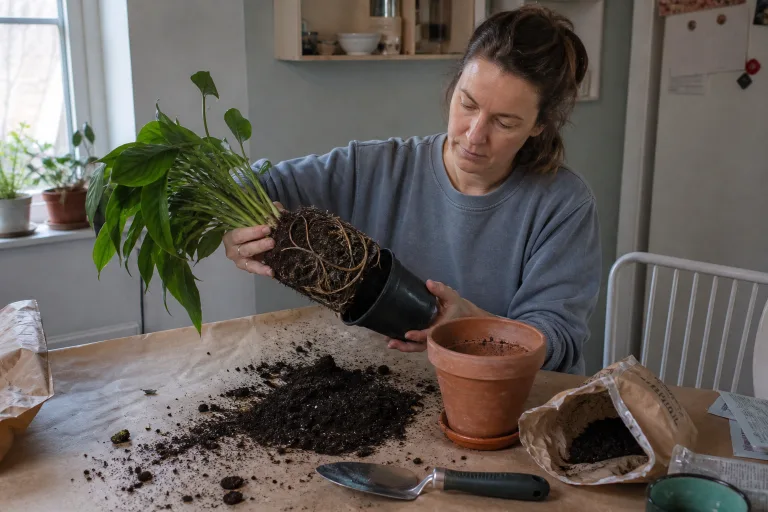
Look for a root-zone reason
Visible roots at a drainage hole do not automatically mean the plant is root-bound. Stronger signs include a dense wall of circling roots, water moving through almost instantly, the mix drying much faster than it used to, instability, or stalled growth despite suitable light and care.
Repot sooner if the mix smells sour, remains wet unusually long, has collapsed into a dense mass, or contains active root rot. That is a corrective repot rather than a simple size increase. A newly purchased plant can usually acclimate first unless the root zone is failing.
Go only modestly larger
Choose a pot with at least one effective drainage hole. For a routine size increase, a diameter 2–5 cm (about 1–2 inches) larger is often enough. Match the increase to the root ball, not the foliage. A large canopy can sit on a surprisingly compact root system.
An oversized pot holds a greater volume of wet mix around roots that cannot use it quickly, increasing the risk of low oxygen and rot. Terracotta dries faster through its porous wall; glazed ceramic and plastic retain moisture longer. Neither is universally better—the choice should support your plant, mix, room, and watering habits.
Build a mix for roots, not a recipe trend
Use a clean mix appropriate for the species. A tropical foliage mix may combine a moisture-retentive base with bark, pumice, or perlite for structure. Succulents need a higher proportion of durable mineral or coarse components. Epiphytes may need very open bark-based media.
Aeration amendments help only when particle size creates connected pores. Turning the mix into fine dust or compressing it tightly defeats that purpose. Pre-moisten very dry mix so it accepts water evenly, but do not turn it into mud.
Particle size should relate to the roots and container. Very coarse media can leave small fine roots without enough contact; very fine media in a deep pot can create a saturated lower zone. Pot geometry, material, and mix work as one system.
Repot step by step
- Prepare first. Gather the draining pot, fresh mix, a tray, and clean pruners. Water a day or two beforehand if the root ball is bone dry and brittle.
- Remove gently. Support the base, tip the pot, and ease the root ball out. Do not pull hard on stems.
- Inspect. Healthy roots are generally firm. Trim black, mushy, hollow, or foul-smelling roots with clean tools. Do not aggressively untangle every healthy root.
- Loosen the outside. Tease only dense circling roots so they can explore the new mix. A severely root-bound plant may need a few shallow vertical cuts, but routine repotting rarely requires major root pruning.
- Set the depth. Add mix below the root ball so the original soil line remains just below the rim. Do not bury the crown or stem.
- Fill around roots. Work mix into large gaps with fingers or a chopstick and tap the pot. Keep structure; do not compact it hard.
- Water to settle. Water evenly and let excess drain, unless the species or a major root-rot treatment calls for a different short recovery approach.
Keep aftercare boring
Return the plant to stable, suitable light without adding intense new sun. Do not fertilize immediately if the fresh mix contains nutrients or roots were damaged. Protect the plant from cold drafts and resist repeated watering just because the upper fresh mix looks dry.
Some temporary droop can follow root disturbance. Judge the moisture lower in the root ball and watch the direction of change. New growth, stable posture, and normal dry-down indicate that roots are re-establishing.
Avoid the common repotting failures
| Problem | Likely cause | Better next step |
|---|---|---|
| Mix stays wet for weeks | Pot too large, low light, dense mix, root loss | Improve conditions and inspect roots if decline continues |
| Plant wilts in wet mix | Root damage or oxygen shortage | Do not keep adding water; assess roots |
| Plant dries every day | Mix too coarse, pot too small, hot bright site | Rebalance the system rather than watering blindly |
| Stem begins to rot | Plant buried deeper than before | Expose the original crown and remove affected tissue |
Before you begin
- Confirm that repotting solves a real problem.
- Select a draining pot only slightly larger.
- Match the mix to plant and room.
- Keep healthy root disturbance minimal.
- Plan stable light and restrained aftercare.
Sources and further reading
Keep a record of the root reset
Save the repotting date and follow new growth in Hanami rather than relying on memory.
Download Hanami