The short answer
There is no accurate universal interval. A pothos might need water after six days in a bright warm room and after sixteen days in a cooler dim room. Check once or twice a week, then water when the mix has dried to the level appropriate for that plant.
Use more than one moisture clue
The surface dries first, so appearance alone can mislead. Push a clean finger into the mix, insert an unfinished wooden skewer for several minutes, or learn the weight of the pot immediately after watering and near its dry point. A clear nursery pot also lets you see condensation, root color, and moisture lower down.
Moisture meters can help compare areas in a large pot, but inexpensive meters vary with soil composition and salts. Treat the reading as one clue, not a command. Always check multiple spots in a large container because the center can stay wet while the edge dries.
| Plant group | Common dry point | Important caveat |
|---|---|---|
| Tropical foliage | Top layer dry; lower mix lightly moist | Thin-leaved species may prefer more even moisture |
| Succulents and cacti | Most or all of the mix dry | Cool dormant plants can need much longer |
| Ferns | Surface beginning to dry | Do not keep the root zone waterlogged |
| Orchids | Depends on species and medium | Read roots and bark, not a houseplant calendar |
Water the root ball, then let it drain
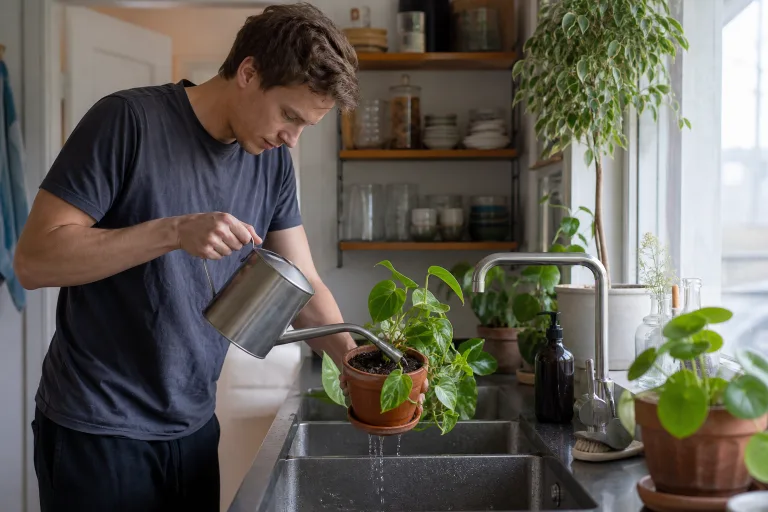
Pour slowly around the surface so the mix wets evenly. Continue until a little water exits the drainage hole. Wait briefly, then empty the saucer or outer pot. This does not mean every plant needs a fixed volume; it means the root ball should not contain dry islands while other areas stay saturated.
If water races down the sides and out immediately, the mix may have shrunk from the pot or become hydrophobic. Water once slowly, wait 10–15 minutes, and water again. A very dry small pot can be soaked from below temporarily, but remove it once the mix is evenly moist and let it drain fully.
Pot weight is a surprisingly useful measurement. For a plant you often misread, weigh it after complete drainage and again at the preferred dry point. The difference estimates how much water the system loses between waterings and reveals seasonal changes without probing roots repeatedly.
Why the same plant dries faster or slower
Brighter light, higher temperature, airflow, active growth, a small pot, a root-bound plant, and a porous terracotta container generally speed water use. Lower light, cooler conditions, a large pot, dense mix, recent root loss, and a nonporous pot generally slow it.
Season changes several variables at once. Winter can bring lower light even in a warm room. Summer heat may increase drying, but closing blinds can reduce light and growth. Follow the pot rather than assuming “weekly in summer, fortnightly in winter.”
Overwatering is a root-zone condition
“Overwatering” usually means the root zone stays wet too long, not that one thorough watering was too generous. Yellow leaves, soft stems, fungus gnats, sour odor, and slow drying can point toward poor aeration or damaged roots. Crisp leaves, curling, dry mix, and a very light pot can point toward drought—but severely damaged roots can also cause wilting in wet soil because they can no longer absorb water.
Check the mix before reacting. If wet soil and wilting appear together, do not automatically add more water. Inspect drainage, roots, and recent conditions. Change one major factor at a time so you can see what helps.
Handle exceptions deliberately
Self-watering pots work when the plant and medium are suited to consistent capillary moisture; they are not ideal for every drought-adapted plant. Pots without drainage make the root-zone status difficult to judge and leave no simple route for excess water—use them as outer cachepots around a draining nursery pot.
Tap water is suitable for many plants. Sensitive species may react to high mineral or fluoride levels, but brown tips can also result from salts, dry air, inconsistent moisture, or root stress. Diagnose the whole pattern before buying a new water system.
Your next watering
- Check below the surface in more than one place.
- Lift the pot and compare its weight.
- Water slowly across the full surface.
- Let excess drain and empty the outer pot.
- Note how many days pass—but do not turn that number into a rule.
Sources and further reading
Keep the pattern, not just the date
Save plant profiles and care notes in Hanami to see how light, season, and watering relate over time.
Download Hanami