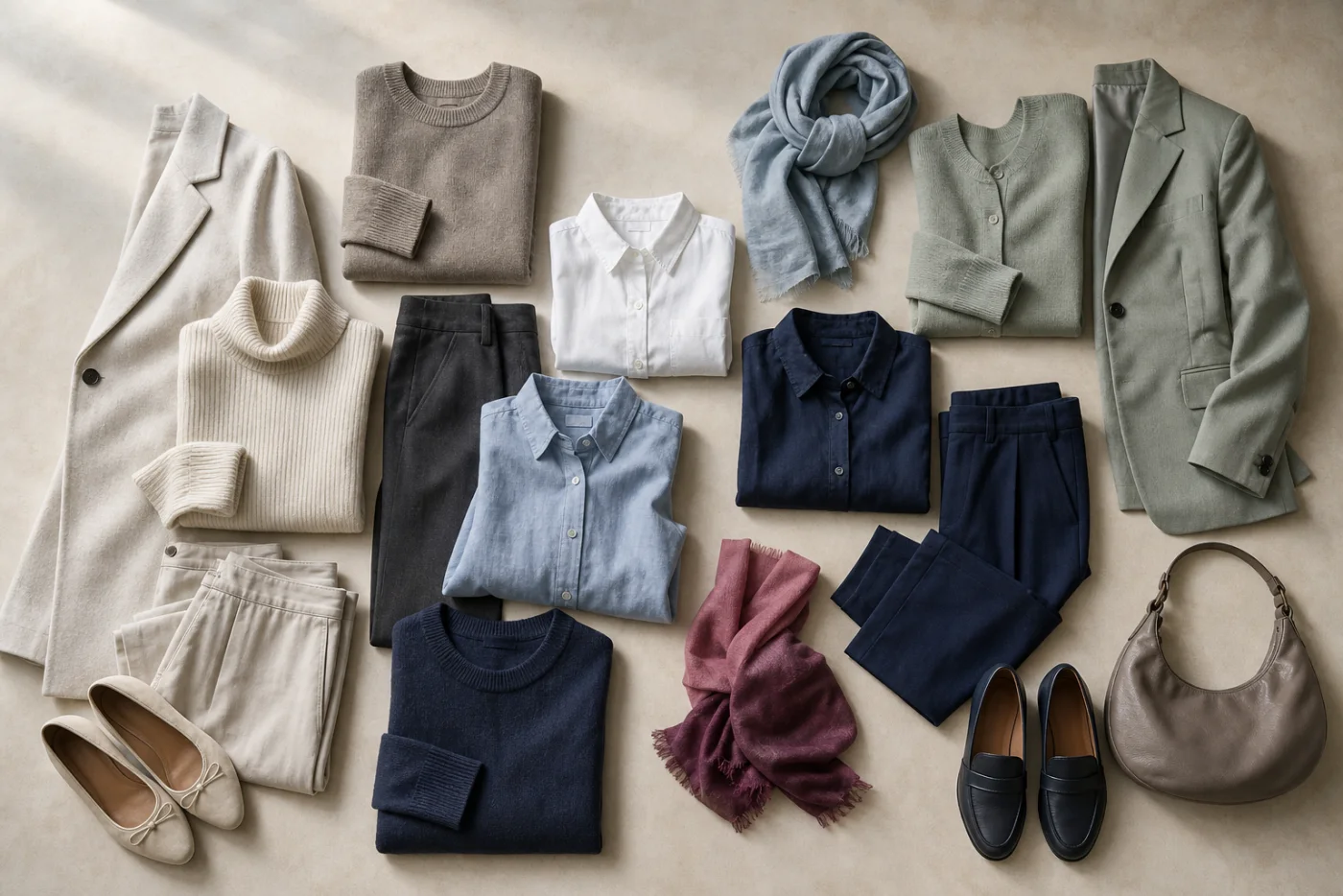
Begin with roles
A useful outfit palette usually has hierarchy. One color occupies most of the visual area, a second supports it, and an optional accent draws attention. The familiar base-main-accent idea is a planning aid, not a mathematical rule.
Neutrals make dependable bases because they combine easily, but neutral does not mean colorless. Soft navy, mushroom, cream, olive, charcoal, and cocoa all carry temperature, value, and chroma.
Four formulas
The same formula can be soft or bold. A monochromatic look in heathered fabrics feels blended, while one in polished saturated fabrics feels graphic. Adjust chroma, value difference, surface finish, and proportion until the combination supports your intention.
- Monochromatic: several values or textures from one hue family.
- Neighboring colors: hues that transition gently, such as blue into blue-green.
- Neutral-led: one or two neutrals with a single signature color.
- Complementary accent: a small contrasting hue used for deliberate energy.
Repeat what already works
Look for combinations inside the wardrobe before buying a new color. If a misty blue top connects three trousers and two jackets, it is more valuable than a perfect isolated swatch. Saved outfit checks can reveal these connector colors over time.
When a combination nearly works, change one variable. Swap pure white for soft white, reduce the accent area, or add a texture that blends the transition. Small adjustments are often more useful than replacing the entire outfit.
Put your color knowledge into practice
Use Chroma to explore your seasonal direction, save a personal palette, and compare colors in clothes and makeup.
Download Chroma