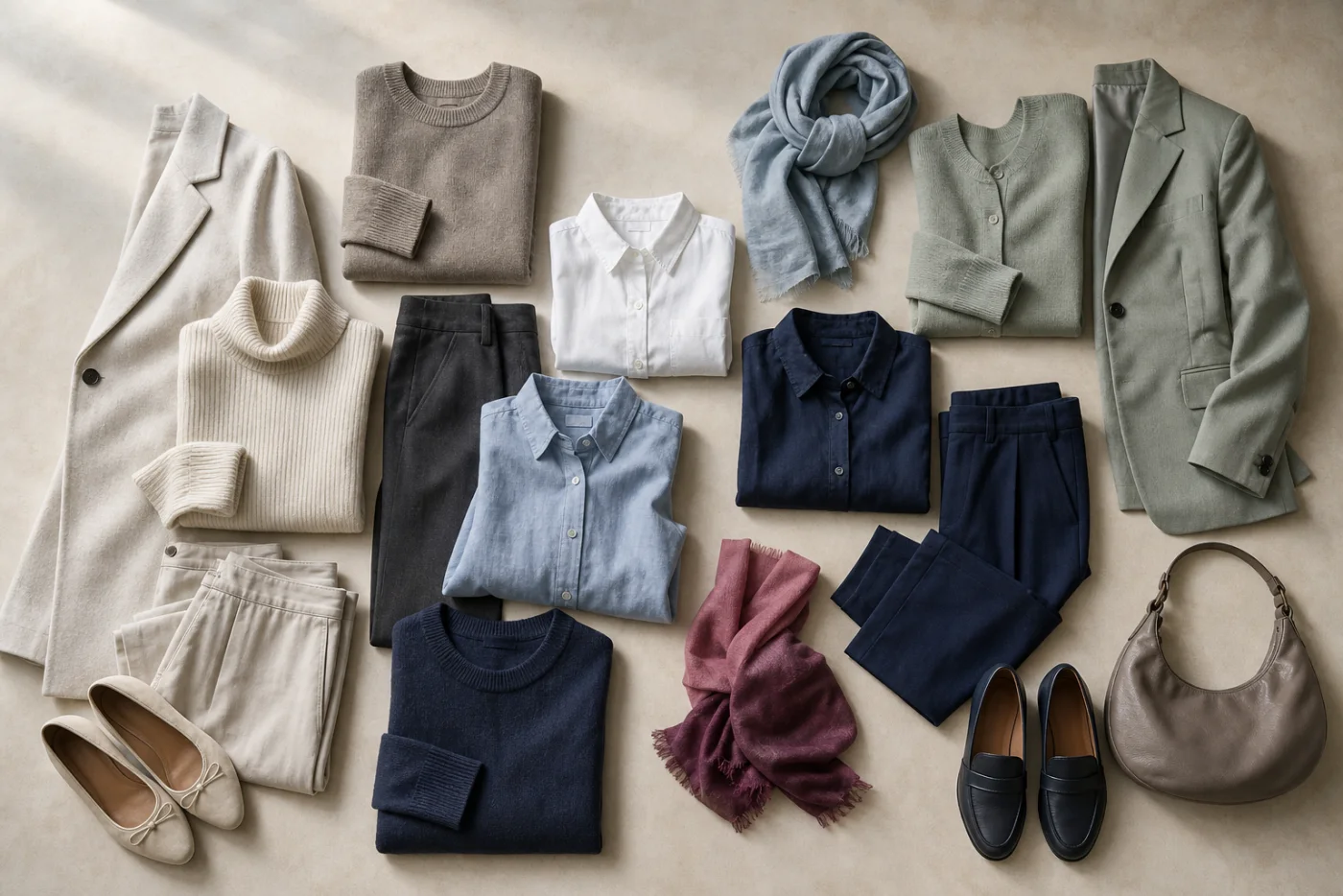
Build the foundation first
A personal palette can contain dozens of appealing colors, but a wardrobe does not need equal amounts of each. Begin with two or three neutrals that suit your lifestyle and combine with one another. Consider a light neutral, a medium neutral, and a dark neutral rather than relying automatically on white, beige, and black.
Your best foundation is the one that supports the clothes you actually wear. A person who lives in denim may treat mid-blue as a neutral. Someone in a formal workplace may rely on navy and charcoal. Climate, laundry habits, and availability matter more than a theoretical ideal.
Add signatures and accents
Signature colors are the hues you enjoy wearing in noticeable areas: tops, dresses, coats, or large knits. Accents are useful in smaller pieces such as scarves, jewelry, socks, bags, or makeup. One color can play either role depending on proportion.
Aim for connection. A signature color becomes more useful when it works with at least two foundations. An accent becomes easier to repeat when it appears in a print or accessory you already own.
- Foundation: combines often and occupies larger areas.
- Signature: expresses your taste and works near the face.
- Accent: adds focus in a smaller proportion.
- Wildcard: outside-palette color you simply love.
Find useful gaps
A wardrobe gap is not every palette color you do not own. It is a missing piece that would connect several existing garments or solve a repeated dressing problem. Before buying, list the exact outfits the new piece would complete.
This approach keeps color analysis from becoming a reason to overbuy. A smaller group of connected colors is often more wearable than a large collection of season-perfect items that do not share fit, function, or style.
Put your color knowledge into practice
Use Chroma to explore your seasonal direction, save a personal palette, and compare colors in clothes and makeup.
Download Chroma