Confirm that compaction is the problem
Compaction compresses large soil pores, slowing water, air exchange, and root growth. It often appears along paths, play areas, gates, parking edges, and on fine-textured soil worked while wet. Signs include shallow roots, hard resistance when moist soil is probed, puddling or runoff, and turf that thins in the traffic pattern.
Do not diagnose from one symptom. Water can run off because of slope, water-repellent dry soil, heavy thatch, or an irrigation rate faster than infiltration. Dig several small plugs and compare the problem area with healthy turf.
Use hollow tines for lasting relief
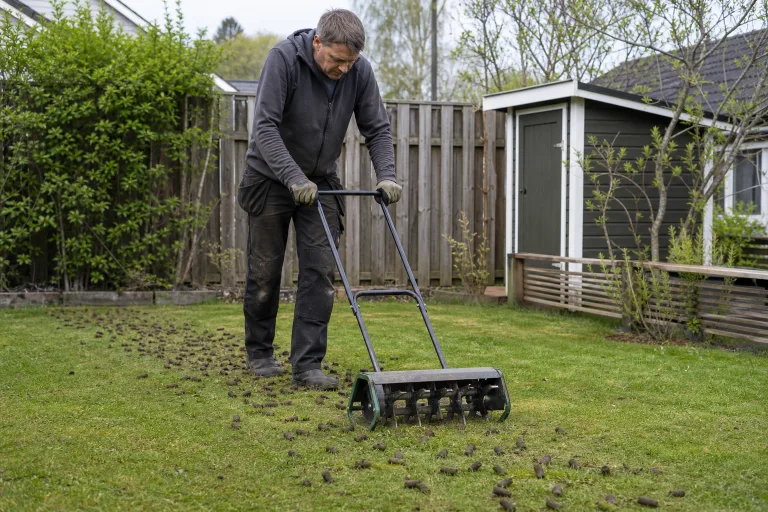
A core aerator removes plugs of soil and creates temporary channels through the compacted layer. Solid spikes mostly push soil sideways and can compact the walls of each hole; sandals and small hand spikes rarely change a large compacted lawn. A garden fork can help a tiny spot if it lifts and fractures soil rather than simply punching holes.
Vertical mowing or scarification cuts through surface material and can help manage thatch, but it is not the same as relieving mineral-soil compaction. Choose the treatment for the layer that is limiting the lawn.
Measure thatch in a wedge cut from the lawn. A modest layer can cushion crowns and reduce evaporation; aggressive removal is justified by measured excess and turf type, not by the presence of any brown material.
Aerate while grass can close the holes
Work during active growth with enough recovery weather ahead. For many cool-season lawns, late summer into early autumn is a strong window; spring may also work after growth resumes. Warm-season turf is usually aerated during reliably warm active growth.
Soil should be moist enough for tines to enter and release intact cores, but not saturated or sticky. Water dry soil in advance, then test it. Avoid aeration during drought stress, dormancy, severe heat, or when machinery would rut the surface.
Core-aerate step by step
- Mark hazards. Flag irrigation heads, valve boxes, shallow cables, drains, edging, and exposed tree roots.
- Mow and water appropriately. Remove excessive leaf height and bring dry soil to workable moisture.
- Test the machine. Confirm tine depth and core release in a safe area.
- Make overlapping passes. Cross severely compacted zones from more than one direction instead of treating good and bad areas identically.
- Leave the cores. Let them dry and crumble back through mowing or light raking. They return mineral soil and microorganisms to the surface.
- Repair during the opening. If the season is suitable, overseed thin cool-season turf and apply only soil-test-based amendments.
Support recovery without smothering the lawn
Resume sensible irrigation so the turf stays actively growing. If seed was added, switch temporarily to the lighter germination routine described in the overseeding guide. Otherwise, continue deeper watering based on soil and weather.
A thin compatible topdressing may help gradual surface improvement, but heavy layers can bury crowns and change grade. Do not automatically add sand to clay: poorly chosen mixtures can create a dense, concrete-like matrix. Match material to the existing soil and a defined purpose.
Avoid the aeration traps
| Mistake | Why it fails | Better move |
|---|---|---|
| Aerating bone-dry soil | Tines penetrate poorly | Moisten, wait, and test |
| Working saturated soil | Machinery smears and ruts it | Wait until workable |
| Using spikes for deep compaction | No soil is removed | Use hollow-core equipment |
| One fast pass | Too few holes in the damaged zone | Use overlapping crossing passes |
| Aerating every year by default | Cost and disturbance without evidence | Repeat only when use and soil justify it |
Sources and further reading
Read the pattern before treating it
Hanami helps you practice the same observation-first approach with the plants around you.
Download Hanami