Before using any lawn calendar
Identify whether the lawn is dominated by cool-season or warm-season grass. Cool-season turf grows most strongly in spring and autumn; warm-season turf grows most strongly from late spring through summer. A fixed “April task” can be perfectly timed in one climate and damaging in another.
Use phenology and measurements: soil warming, first consistent growth, mowing frequency, heat stress, dormancy, frost risk, and rainfall. Local agricultural extension services publish calendars aligned with regional grasses, regulations, pests, and planting windows. This guide provides the decision framework.
Spring: resume care without forcing growth
Cool-season lawns
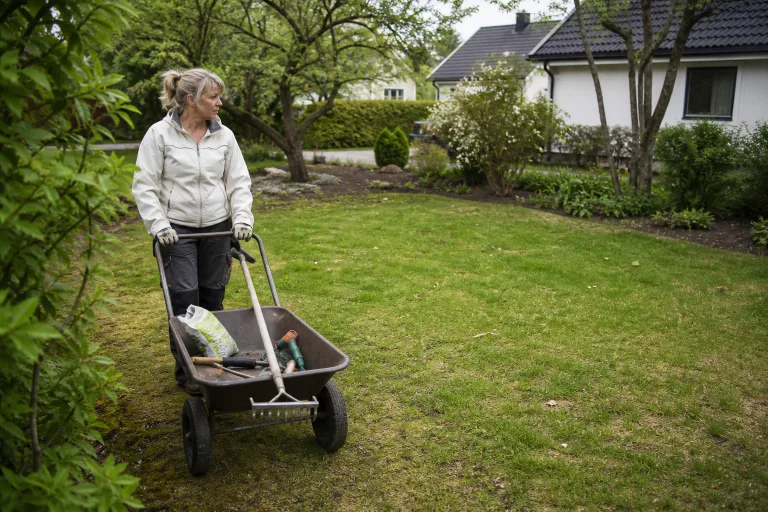
Rake only enough to remove smothering debris after the soil firms. Resume mowing when growth starts, using a sharp blade and the normal species range. Spring is a useful time to test soil, repair irrigation, edge beds, and map winter injury.
Apply nitrogen modestly and only if the turf program calls for it; heavy spring nitrogen can create excessive leaf growth and weaker summer performance. Spring seeding is possible where autumn was missed, but prepare for summer watering and check conflicts with pre-emergent herbicides. Aerate only if compaction is real and the grass has enough active growth to recover.
Warm-season lawns
Wait for consistent green-up before pushing growth. Remove winter debris lightly and mow at the recommended height as the turf resumes. A very low seasonal scalp is used in some regional programs for certain warm-season grasses, but it is species- and climate-specific and not a universal requirement.
Test soil and repair irrigation before peak demand. Apply nitrogen after the lawn is actively growing—not on dormant brown turf. Begin aeration, dethatching, plugging, or repair only when warm-season grass can fill back in.
Summer: protect roots and manage demand
Cool-season lawns
Raise mowing height toward the upper useful range, keep the blade sharp, and reduce traffic during heat or drought. Measure irrigation, water early, and use cycle-and-soak where runoff occurs. Do not use high nitrogen to paint stressed turf green. Avoid aggressive aeration, dethatching, and broad renovation during sustained heat.
Decide whether to irrigate for active growth or allow suitable turf to become dormant under local guidance. Avoid cycling repeatedly between dormancy and growth. Watch for disease when nights are warm and leaves stay wet, and identify insects before treating.
Warm-season lawns
This is the main growth and recovery period for many warm-season grasses. Mow frequently enough to follow the one-third rule, calibrate irrigation, and apply test-supported nutrition. Aeration, dethatching, seeding for seed-grown species, plugging, sprigging, and sod repair often fit here while sufficient warm growth remains.
Heat does not eliminate water stress. Inspect hot edges, shallow soil, slopes, and irrigation distribution. Excess water and nitrogen can still increase disease or thatch.
Weather-based controllers estimate irrigation need from evapotranspiration, but the landscape coefficient, sprinkler precipitation rate, distribution uniformity, rooting depth, and allowable depletion still need sensible inputs. A “smart” controller on an unmeasured system automates an assumption.
Autumn: renovate cool-season turf and prepare warm-season turf to slow
Cool-season lawns
Late summer into early autumn is often the strongest renovation window. Soil is warm enough for germination while cooler air supports growth. Overseed, repair bare areas, core-aerate compacted soil, and dethatch where measured thatch requires it. Complete seeding with enough time for establishment before hard frost.
Continue mowing as long as grass grows; leaves do not read the calendar. Apply nitrogen and potassium only within the regional program and soil results. Remove heavy leaf cover promptly—mulching a light layer with frequent mowing can work, but wet mats block light and airflow.
Warm-season lawns
As growth slows, reduce nitrogen so tender late growth is not forced into cold. Continue mowing at the normal range until growth stops and clear smothering debris. Manage water from actual use; cooler dormant-approach weather usually reduces demand.
Winter overseeding with cool-season ryegrass is a specialized aesthetic and playability program that competes with the warm-season base and adds water, mowing, transition, and disease management. Do it only with a clear reason and regional plan.
Winter: prevent avoidable damage
Cool-season lawns
Growth may continue slowly in mild climates or stop under snow and frozen soil. Keep heavy leaves and objects from smothering the lawn. Limit traffic on frost-covered or saturated turf because brittle leaves and soft soil recover slowly. Service the mower, sharpen blades, inspect irrigation, and plan soil testing or renovation supplies.
Warm-season lawns
Dormant brown color is normal in cold weather. Do not apply nitrogen to force growth that temperatures cannot sustain. Control winter weeds only with products labeled for the turf, weed, and growth state, and follow local regulations. Prevent concentrated foot or vehicle traffic on dormant grass.
Do not pile snow mixed with deicing salt onto turf if another location is available. Where snow mold is a recurring concern, manage autumn nitrogen, leaf cover, drainage, and snow compaction before symptoms appear.
Let growth signals move the schedule
| Signal | What it changes | Example decision |
|---|---|---|
| Mowing frequency rises | Growth is active | Begin or increase growth-supporting tasks |
| Footprints remain | Water is becoming limiting | Check root-zone moisture and forecast |
| Soil is cold but air warms | Roots and microbes lag | Avoid forcing growth from a calendar date |
| First expected frost approaches | Establishment window is closing | Do not start slow-germinating seed too late |
| Growth shuts down | Recovery capacity falls | Stop disruptive work and reduce feeding |
Weed and pest timing also follows biological stages. Crabgrass germination, grub vulnerability, and disease risk do not begin on the same date every year. Identify the target and use local degree-day or phenology guidance when precision matters.
Keep records that improve next year
Record the first and last mow, major weather, irrigation catch-can results, soil test values, product and nutrient amounts, seeding cultivar and date, germination, and fixed-point photos. Note what you did not do as well—skipped treatments can reveal that a ritual was unnecessary.
At year-end, ask which change improved density, roots, or recovery and which only changed color briefly. Move next year’s timing based on lawn response, not memory.
Your year in seven anchors
- First consistent growth
- Soil test and irrigation audit
- Peak mowing demand
- First sustained heat stress
- Best renovation window
- Growth slowdown and final mowing period
- Dormancy protection and equipment service
Sources and further reading
Let the plant set the pace
Hanami helps you observe, identify, and record care context—the same skills that make lawn calendars useful.
Download Hanami