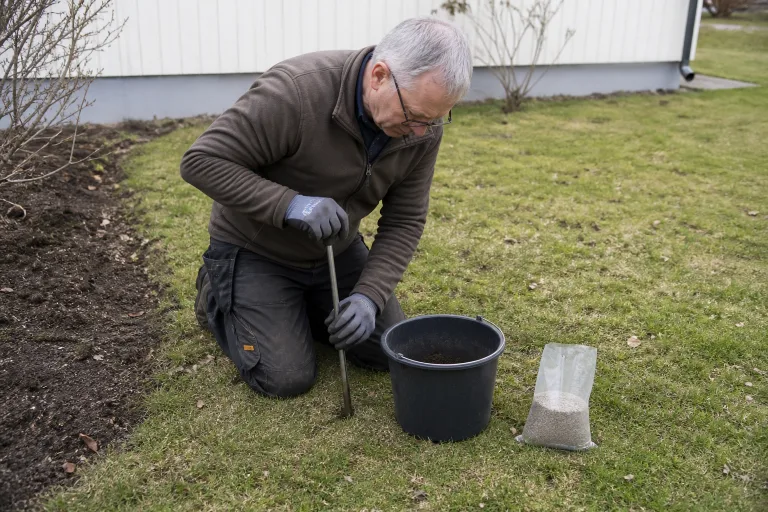
Take a representative soil sample
Choose a reputable regional laboratory or agricultural extension service and use its kit and instructions. Sample when soil is workable and before applying fertilizer or lime. Divide obviously different areas—front and back lawn, sandy fill and native soil, healthy and chronically failing zones—into separate tests.
- Remove grass blades, thatch, and surface debris.
- Take thin cores from the lab’s specified depth at 10–15 representative spots.
- Avoid fertilizer spills, pet spots, compost piles, road salt edges, and unusual depressions unless testing them separately.
- Mix the cores in a clean non-galvanized container and submit the required amount.
- Record the date and approximate sampling points for comparison later.
A home pH probe can show trends but usually does not replace a lab report with calibrated extraction methods and nutrient recommendations.
Read pH, phosphorus, and potassium in context
Soil pH affects nutrient availability and species performance. The ideal range varies with grass and soil; follow the report rather than chasing a universal number. Lime raises pH and supplies calcium or magnesium depending on the material. Sulfur can lower pH in some conditions, but the amount, reaction time, and safety depend strongly on soil chemistry.
Phosphorus supports establishment and energy transfer but can pollute water when overapplied or moved with eroded soil. Some regions restrict phosphorus unless a test or new-seeding condition supports it. Potassium influences stress responses, but “winterizer” claims should not override an adequate test result.
| Report item | What it helps answer | What it does not answer alone |
|---|---|---|
| pH and buffer index | Whether and how strongly pH correction may be needed | Why a single patch died |
| Phosphorus | Whether soil supply is likely sufficient | Whether roots can access water or oxygen |
| Potassium | Whether supplemental K is justified | How much nitrogen growth requires |
| Organic matter | Context for soil behavior and nutrient cycling | Whether surface thatch is excessive |
Nitrogen follows grass growth and management
Standard soil tests often do not prescribe nitrogen from a stable soil concentration because plant-available nitrogen changes quickly. Recommendations instead use grass species, expected growth, clipping return, season, soil, and maintenance level.
Apply nitrogen when the grass is actively growing and able to use it. Too much creates surge growth, more mowing, weaker tissues, disease pressure, and leaching risk. Too little can limit density where every other growth factor is adequate. Returning clippings recycles some nitrogen and can reduce future needs.
Slow-release nitrogen supplies a portion over time and can smooth growth. Soluble nitrogen acts more quickly and can be used precisely but has a smaller margin for error. Read the guaranteed analysis, release source, application rate, watering instructions, and legal restrictions.
Tissue color is a weak nitrogen meter by itself. Genetics, temperature, iron, root function, drought, disease, and light all affect green color. Compare growth rate, density, clipping yield, recent inputs, and test context before chasing darkness.
Calculate the product amount
The three large numbers on a fertilizer label are percentages by weight of nitrogen (N), phosphate (P₂O₅), and potash (K₂O) in that order. A 20-0-10 fertilizer is 20% nitrogen.
Product mass = desired nutrient mass ÷ decimal nutrient fractionIf a trusted recommendation calls for 0.25 kg of nitrogen over a measured area, a 20% nitrogen product would require 0.25 ÷ 0.20 = 1.25 kg of product over that area. The arithmetic does not decide the nutrient target; it only converts a justified target into product.
Measure lawn area accurately and subtract beds, paving, ponds, and buildings. Break irregular shapes into rectangles, triangles, and circles. Recheck unit conversions—especially pounds per 1,000 square feet versus kilograms per 100 square meters.
Calibrate the spreader instead of trusting a setting
- Measure and mark a test area.
- Weigh a small amount of product.
- Set the spreader below the suggested setting and cover the area at your normal pace.
- Weigh what remains to calculate application.
- Adjust and repeat until the rate is correct.
- For the final lawn, divide product into two crossing passes to improve uniformity.
Close the spreader while turning, keep a consistent walking speed and overlap, and use a border deflector near beds and water. Sweep granules from hard surfaces back onto the turf. Apply only in suitable weather and follow label requirements for watering and protective equipment.
Treat physical soil problems physically
Fertilizer cannot create pore space in compacted soil. Diagnose compaction by inspecting roots, infiltration, bulk resistance, and traffic patterns. Core aeration removes plugs and creates temporary channels; solid tines can smear or compress some soils. Time aeration during active growth when turf can recover.
Thatch is the springy organic layer between green tissue and mineral soil. A thin layer cushions crowns and reduces evaporation. An excessive layer can hold roots above soil, repel water, harbor pests, and interfere with products. Measure it in a plug. Management can include correcting excessive nitrogen and irrigation, core aeration, and species-appropriate dethatching.
Topdressing can smooth minor irregularities and gradually modify the surface, but material should be compatible with the existing root-zone soil. Repeated layers with sharply different texture can disrupt water movement. Never bury living turf under a thick load.
The evidence-first order
- Map the lawn and take representative soil samples.
- Correct pH and nutrients only from results.
- Calculate and calibrate rather than estimate.
- Use physical remedies for compaction and thatch.
- Retest on the lab’s recommended interval, not after every application.
Sources and further reading
Feed what can actually grow
Hanami helps organize observations for the plants in your care—because context beats a one-size-fits-all schedule.
Download Hanami