First, define a “perfect” lawn that can stay healthy
The most useful goal is dense, even turf that covers soil, tolerates normal use, recovers from stress, and fits the available time and water. It does not have to be neon green every day or cut like a putting surface. Chasing that look can lead to excessive nitrogen, shallow roots, disease pressure, and unnecessary inputs.
Choose your tolerance for seasonal dormancy, clover, minor color variation, wear, and irrigation. A practical standard makes decisions clearer: fix bare soil and active decline first; improve density and consistency second; fine-tune color and presentation last.
Know your grass type and growth season
Cool-season grasses—such as Kentucky bluegrass, perennial ryegrass, and fine or tall fescues—grow most actively in spring and autumn and can struggle in sustained summer heat. Warm-season grasses—such as bermudagrass, zoysiagrass, St. Augustinegrass, and centipedegrass—grow most actively in warm weather and commonly go dormant when temperatures fall.
This distinction controls mowing height, fertilizing windows, aeration timing, overseeding decisions, and how you interpret seasonal browning. Identify the dominant grass rather than following a calendar written for another region.
| System | Strong growth | Best major work | Common mistake |
|---|---|---|---|
| Cool-season turf | Spring and autumn | Late-summer to early-autumn seeding; active-growth aeration | Heavy renovation or high nitrogen during summer heat |
| Warm-season turf | Late spring through summer | Late-spring or early-summer establishment and aeration | Feeding heavily as growth shuts down |
| Mixed transition zone | Species and weather dependent | Use local extension timing and cultivar advice | Applying a northern or southern schedule unchanged |
If you are unsure, compare blade width, tip shape, growth habit, stolons or rhizomes, ligule and collar details, and seed heads. Local agricultural extension services can help confirm grass and recommended cultivars for your site.
Audit the site before you treat the symptoms
Walk the lawn slowly and map the pattern. Is thinning limited to shade, a dog route, a low wet spot, a hot pavement edge, or the whole lawn? Does water run off, pool, or disappear quickly? Can you push a screwdriver into moist soil, or does compaction stop it? How deep are the roots? How much thatch sits between green tissue and soil?
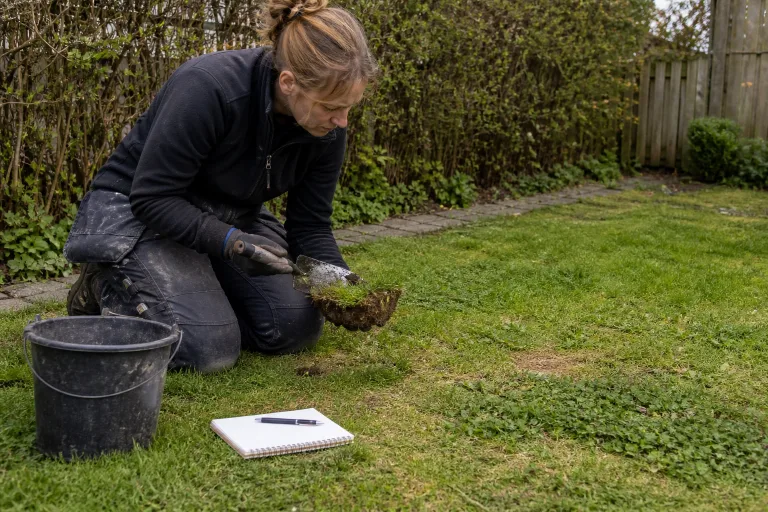
Dig a few small plugs 8–15 cm (3–6 inches) deep. Look at root depth, soil texture, odor, insects, and the transition between surface organic matter and mineral soil. Healthy turf depends on the volume of soil roots can explore, not just the color above it.
The five-part lawn audit
- Grass: type, density, height, growth stage, and dormancy.
- Site: daily sun, slope, heat reflection, traffic, and drainage.
- Soil: test pH and nutrients; inspect compaction and rooting depth.
- Water: measure irrigation output and distribution; account for rain.
- Pattern: record where weeds, disease, insects, and thin areas occur.
Photos taken from the same fixed points every two to four weeks show whether density is improving. Avoid using color alone: a quick nitrogen response can make weak turf greener without solving root or species problems.
Mow to leave enough leaf for strong roots
Set height for the grass species and season, then follow the one-third rule: remove no more than roughly one-third of the blade in one mowing. If the lawn grows beyond that, raise the deck for the first pass and lower it gradually over later mowings. Repeated scalping reduces photosynthetic area, exposes crowns, heats soil, and gives weeds room.
Keep the blade sharp. Ragged, pale tips after mowing indicate tearing rather than a clean cut. Mow when the leaf is dry, vary the direction, and return fine clippings unless they form piles or the lawn has a specific disease or contamination issue. Clippings are mostly water and nutrients; they do not normally create thatch.
Height guidance varies by grass and cultivar. Many cool-season home lawns perform well around 6–10 cm (2.5–4 inches), with taller mowing helping during heat and shade. Some warm-season species are maintained shorter, but the correct range depends on species and mower type. Read the full correct lawn mowing guide.
Quality is not only deck height. Reel mowers cut with a scissor action and can support very low heights on suitable dense turf; rotary mowers need enough height and blade tip speed for a clean cut. Never copy a sports-turf height without the matching grass, mower, irrigation, leveling, and maintenance intensity.
Water the root zone—not the calendar
Established turf usually benefits from deeper, less frequent irrigation rather than daily shallow watering, but soil depth, species, weather, shade, slope, and local restrictions matter. Use the lawn’s first stress signals—footprints that remain, folded blades, dull bluish-green color—alongside soil moisture and the forecast.
Measure sprinkler output with several identical straight-sided containers placed across each zone. After a timed run, compare depths. Large differences indicate poor distribution that extra runtime will not fix. Use cycle-and-soak irrigation on slopes or compacted soil: divide the total into shorter cycles with absorption time between them.
Application depth = average container depth during the measured runCheck how deep the water moved with a screwdriver or small soil plug after irrigation. Stop before runoff. New seed needs frequent light moisture at the surface until germination and establishment; that is a temporary exception, not the permanent lawn schedule. See how to water a lawn deeply for measurement examples.
Test soil before applying fertilizer or lime
A laboratory soil test can report pH, phosphorus, potassium, organic matter, and region-specific recommendations. Sample multiple representative spots, avoid unusual patches unless testing them separately, remove surface litter, and follow the lab’s depth instructions. Do not add lime simply because a lawn looks weak; excessive pH correction can create new nutrient problems.
Nitrogen drives leaf growth and color, but the right amount depends on grass type, season, soil, clippings, irrigation, and local regulation. Feed during active growth, apply evenly, calibrate the spreader, and sweep granules off hard surfaces. Slow-release sources can reduce surge growth; quick-release sources have uses but require accurate timing and watering.
Product needed = desired nutrient amount ÷ nutrient fraction on the labelFor example, a fertilizer labeled 20-0-10 contains 20% nitrogen by weight. The calculation tells you product mass, but the desired nitrogen rate should come from the soil report or a reputable local turf program—not from the formula alone.
Core aeration is useful when compaction restricts air, water, and roots. It is not an automatic annual ritual for every lawn. Aerate while the grass is actively growing and can recover. Thatch is the resilient layer of stems, roots, and rhizomes between green leaves and soil; a thin layer can be useful, while an excessive layer may require species-appropriate management. Read the soil testing and fertilizer guide before buying amendments.
Repair thin turf at the right biological moment
Overseeding can increase density and introduce improved cultivars when existing turf is thin but the site is otherwise suitable. It will not solve deep shade, chronic waterlogging, severe compaction, or an incompatible grass. Correct the cause first.
For cool-season lawns, late summer to early autumn often combines warm soil, cooler air, and lower annual-weed pressure. For warm-season lawns, seed or vegetative repair is usually timed during active warm growth; some species are commonly established by sod, plugs, or sprigs rather than seed.
Mow lower only within the safe range, remove heavy debris, open the surface with aeration, scarification, or a slit seeder as appropriate, distribute a region-appropriate seed blend, and ensure direct seed-to-soil contact. Keep the seed zone consistently moist until germination, then gradually water deeper and less often. Delay normal traffic and mow when seedlings are tall enough to lose no more than one-third.
Detailed rates vary by seed and species. Follow the seed label and local cultivar guidance. The complete process is in how to overseed a lawn.
Germination percentage is not the same as field establishment. Seeding rate must account for seed size, pure live seed, expected mortality, distribution, and the density target. More seed can increase competition and disease rather than creating a better stand.
Treat weeds as information
Dense turf is the first weed-control tool because it occupies light and soil space. Repeated low mowing can favor low-growing weeds; compaction can favor plants adapted to hard soil; wet areas support a different set than dry pavement edges. Identify the weed and the site condition before choosing control.
Hand removal works for small populations if the crown or perennial root is removed. Cultural correction—height, drainage, fertility, compaction, and density—reduces reinvasion. If using an herbicide, choose one labeled for the weed and lawn species, follow the label exactly, protect nearby plants and water, and observe local rules. Newly seeded turf may require a waiting period before or after many herbicides.
Not every non-grass plant is failure. A lawn with some clover or seasonal flowers may support pollinators and require less nitrogen, depending on use and preference. Set the goal before declaring every broadleaf plant a problem.
Build the year around active growth
The highest-value tasks are often simple and repeated: mow at the right height, measure water, keep equipment sharp, and observe. Schedule disruptive tasks when the turf can recover. Schedule fertilizer when the grass can use it. Schedule seeding when temperature, moisture, and weed competition favor establishment.
| Moment | Cool-season focus | Warm-season focus |
|---|---|---|
| Growth begins | Clean up lightly, resume mowing, test soil | Wait for reliable green-up; avoid forcing dormant turf |
| Peak active growth | Mow consistently; modest nutrition as needed | Mow, feed, aerate, and repair when fully active |
| Heat or drought stress | Raise height, reduce disruption, manage water | Maintain active turf while avoiding drought stress |
| Primary renovation window | Late summer to early autumn in many regions | Late spring to early summer in many regions |
| Dormancy approach | Support winter hardiness; clear smothering debris | Reduce nitrogen as growth slows; manage dormancy expectations |
Use the full seasonal lawn care calendar and shift it for your grass, latitude, weather, and local regulations.
Diagnose patterns before adding products
| What you see | Start by checking | Do not assume |
|---|---|---|
| Uniform pale color | Growth stage, nitrogen history, root health, pH | That more fertilizer is always needed |
| Small straw-colored circles | Disease pattern, pet urine, irrigation, insects | That every circle is fungus |
| Thin under trees | Daily light, root competition, moisture, species | That extra seed can defeat deep shade |
| Water runs off | Compaction, slope, thatch, application rate | That longer runtime improves infiltration |
| Turf lifts like loose carpet | Root-feeding grubs or severe root loss | That visible insects are always above ground |
When disease or insects are suspected, collect clear images of the transition between healthy and affected turf and inspect below the surface. Local extension diagnostics can prevent unnecessary treatments.
Your practical improvement plan
- Week 1: Identify the grass, map sun and problem areas, measure mowing height and sprinkler output, and submit a soil sample.
- Weeks 2–4: Correct mowing, irrigation distribution, runoff, and obvious compaction or drainage problems. Wait for soil results before amendments.
- Next active-growth window: Aerate only if needed, correct nutrients and pH from evidence, and overseed or repair with adapted grass.
- Following 8–12 weeks: Protect establishment, mow correctly, reduce irrigation frequency as roots deepen, and photograph fixed points.
- Next year: Repeat measurements, not every treatment. Keep what worked and remove rituals that did not solve a measured problem.
Sources and further reading
Observe first. Improve with confidence.
Hanami helps identify plants and organize visible care clues. Use the same calm, evidence-first mindset from your pots to your lawn.
Download Hanami