Understand what lime can change
Agricultural lime neutralizes soil acidity and can raise pH. That shift changes nutrient availability and the soil environment. It may help grass use nutrients when the soil is too acidic for the species, but it does not act as fertilizer and cannot repair shade, compaction, poor drainage, dull mower damage, or incorrect irrigation.
Grass types differ in their preferred range, and soils resist pH change by different amounts. Two lawns with the same pH can need different quantities of lime because their buffering capacity differs.
Take a representative soil sample
- Divide unlike areas. Sample the main lawn separately from filled soil, wet pockets, vegetable beds, or visibly unusual patches.
- Collect multiple cores. Follow the laboratory’s depth instructions and remove surface leaves or thatch.
- Mix thoroughly. Combine similar cores in a clean container and submit the specified amount.
- Share the intended use. Mark the sample as established lawn or new lawn so the lab can use an appropriate target.
- Read the whole report. Texture, organic matter, phosphorus, potassium, pH, and lime guidance work together.
Home test kits can reveal broad trends, but laboratories provide calibrated methods and regional recommendations. Retest when establishing a lawn, diagnosing a persistent problem, or after the local lab’s suggested interval.
Compare the material, not just the bag weight
Calcitic lime mainly supplies calcium carbonate. Dolomitic lime also contains magnesium and is appropriate when the report or regional soil guidance indicates magnesium is needed. Adding magnesium without evidence is not automatically beneficial.
Products differ in purity, fineness, moisture, and effective neutralizing value. Fine material reacts faster but can be dusty; pelletized lime is easier to spread because fine particles are bound into granules, but the soil reaction still comes from the underlying limestone.
| Label detail | Why it matters |
|---|---|
| Calcium carbonate equivalent | Neutralizing capacity relative to pure calcium carbonate |
| Particle-size or fineness rating | Smaller particles expose more reactive surface |
| Effective neutralizing value | Combines quality factors where regional labels use it |
| Calcium and magnesium | Helps match the soil-test recommendation |
| Application directions | Provides product-specific rate and spreader guidance |
Measure, calibrate, and keep it on the lawn
Calculate the lawn area and buy the amount required by the lab recommendation after adjusting for the product label. If the required correction is large, follow local guidance on splitting it into applications. More at once is not better.
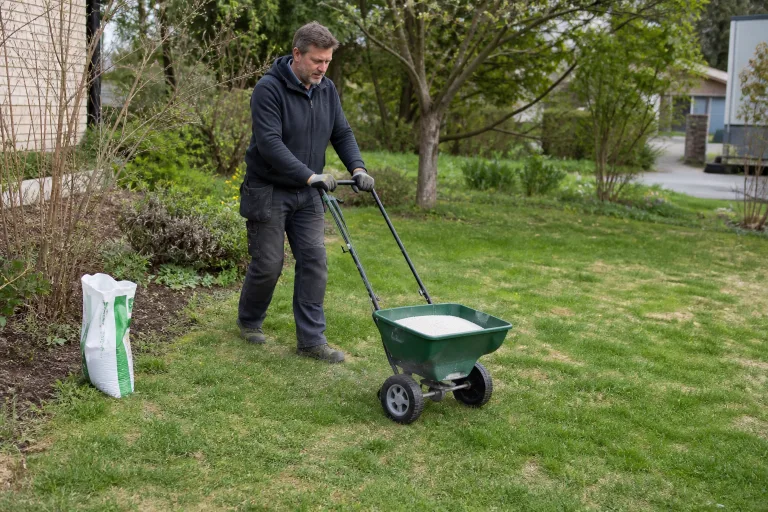
Product needed = recommended treated area × adjusted label rateUse a spreader suited to the material, divide the product into crossing passes, and sweep granules off paving. Avoid windy conditions and follow the label for watering, protective equipment, and timing around other products. Lime reacts gradually; allow the recommended interval before retesting or adding more.
When renovating, incorporation into the prepared root zone can make a prescribed amendment more effective. On established turf, lime remains surface-applied and moves slowly, which is another reason to avoid chasing a quick visual response.
Do not use moss as a pH test
Moss can thrive where turf is limited by shade, moisture, compaction, low fertility, close mowing, or acidic soil. Lime helps only when low pH is one of the measured limits. If the site remains dark and wet, changing pH will not create the light, drainage, or grass adaptation that turf needs.
Map the moss pattern, measure light, inspect drainage, check mowing height, and test soil. In deeply shaded or persistently damp areas, accepting moss or choosing a suitable groundcover may be more durable than repeated products.
Avoid the costly shortcuts
Never lime because…
- The lawn is pale; nitrogen, roots, water, disease, and dormancy can all affect color.
- A neighbor does it each spring; adjacent soils and management can differ.
- Moss is present; moss is a site clue, not a laboratory result.
- The fertilizer bag suggests it; nutrient and pH needs are separate measurements.
- “Natural” means harmless; excessive pH correction can restrict nutrients and waste material.
If pH is already high, adding lime moves the soil farther from the goal. Use the soil testing and fertilizer guide to interpret the amendment as part of the whole lawn system.
Sources and further reading
Replace habit with evidence
Hanami helps turn visible clues into calmer, more informed plant-care decisions.
Download Hanami