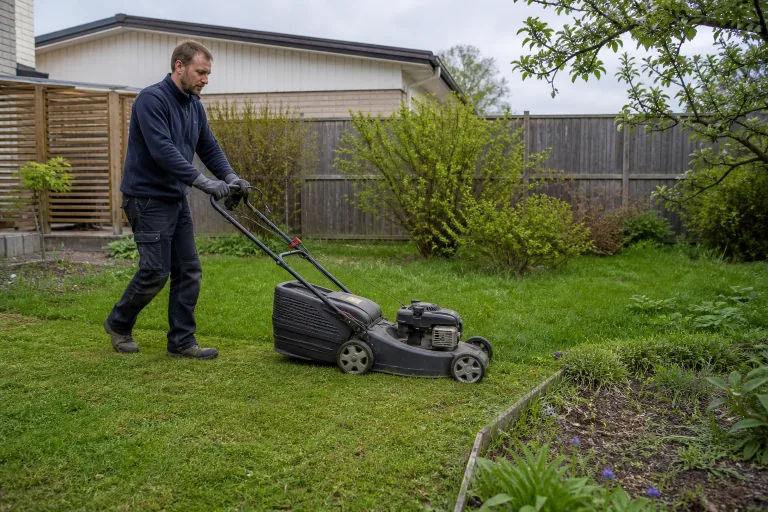
Choose height for the grass—not the neighbor
Identify the dominant species and look up a regional home-lawn range. Many cool-season lawns are maintained around 6–10 cm (2.5–4 inches), while several warm-season grasses tolerate or require shorter cuts. Cultivar, shade, season, mower type, and the surface quality all influence the useful range.
Taller leaf area generally supports deeper roots, shades soil, and makes it harder for some weeds to establish. But “taller is always better” also has limits: grass far above its adapted range can lodge, stay wet, and thin below. Choose a stable target within the species range.
| Situation | Height adjustment | Reason |
|---|---|---|
| Summer heat or drought risk | Use the upper end of the range | More leaf area and soil shade |
| Moderate shade | Often mow taller | Compensates partly for lower light |
| New seedlings | Wait until safely above target | Avoid uprooting and one-third violations |
| Last cut before dormancy | Stay within the normal range | Avoid both scalping and long matted leaves |
Use the one-third rule to set frequency
Remove no more than about one-third of the standing blade height in one cut. If your target is 7.5 cm (3 inches), mow before the lawn grows much beyond roughly 11 cm (4.5 inches). This is a guide, not a reason to measure every blade, but it prevents severe leaf loss.
Maximum starting height ≈ target height ÷ ⅔Fast spring growth may require mowing twice a week; heat or dormancy may require much less. Calendar frequency should follow growth. If a lawn becomes overgrown, raise the deck and reduce height over two or more mowings rather than cutting directly to target.
Cut dry grass with a sharp blade
A dull blade tears leaves, leaving pale frayed ends and a larger wound. Inspect the lawn a day after mowing. If the tips look shredded, sharpen or replace the blade. Frequency depends on lawn size, debris, soil contact, and mower use; inspect performance rather than relying only on annual service.
Mow when leaves are dry enough not to clump and when soil is firm enough to avoid ruts. Avoid the hottest part of a stressful day when possible. Remove stones, branches, toys, and other hazards first, keep guards in place, wear closed footwear and eye protection, and follow the mower manufacturer’s slope guidance.
Deck height markings are often relative, not an accurate measurement of final turf height. Mow a test strip, then measure several standing blades on a level area with a ruler. Tire sink, thatch, uneven ground, and deck pitch can change actual height of cut.
Return fine clippings
Clippings decompose quickly and return nutrients and organic material. They do not normally cause thatch, which is built mostly from slowly decomposing stems, roots, rhizomes, and stolons. Mulch or discharge clippings so they spread evenly.
Collect only when clippings form piles that smother the lawn, when removing a large amount after unavoidable overgrowth, when weed seed heads must be contained, or when a specific disease or contamination plan calls for removal. If clumps form during ordinary mowing, the grass may be too wet, too long, or the mower may need cleaning or service.
Vary the mowing direction
Alternating direction reduces repeated wheel tracks, limits grass leaning one way, and can improve cut uniformity. Use long, safe passes with a small overlap. Avoid pivoting sharply in place on soft turf, which can tear crowns.
Stripes are light reflecting from blades bent in different directions; they are not proof of plant health. A roller can intensify them, but adding weight and traffic is not always helpful on compacted or wet soil. Prioritize an even clean cut before presentation.
Adjust for difficult situations
On a bumpy lawn, a high deck and smaller mower may reduce scalping. Repeated scalped ridges indicate a grading issue that height alone cannot fully solve. On slopes, use equipment and travel directions specified by the manufacturer; slope safety differs for walk-behind and riding equipment.
Do not mow dormant, frozen, or saturated turf simply to tidy it. Limit traffic when grass cannot recover. After overseeding, wait until seedlings are rooted and tall enough for a one-third-safe cut; use a light mower and turn gently.
Before the next mow
- Confirm the species-appropriate target height.
- Measure actual cut height, not just the deck number.
- Check the blade and remove hazards.
- Mow dry leaves without removing more than one-third.
- Return fine clippings and change direction next time.
Sources and further reading
Make every cut support the roots
Use Hanami’s evidence-first plant mindset to observe patterns, record changes, and improve one decision at a time.
Download Hanami