Aim for a moist root zone, then allow air back in
For established turf, deeper and less frequent watering generally encourages roots to use more of the available soil than daily surface sprinkling. But the right interval changes with soil depth, texture, grass type, temperature, wind, sun, slope, and root health. There is no universal number of minutes or days.
Let the lawn tell you when water is becoming limiting. Early signs include footprints that remain after walking, blades folding lengthwise, and a dull bluish or gray-green cast. Confirm with soil moisture before severe wilting. Water before damage, not before any stress signal can develop.
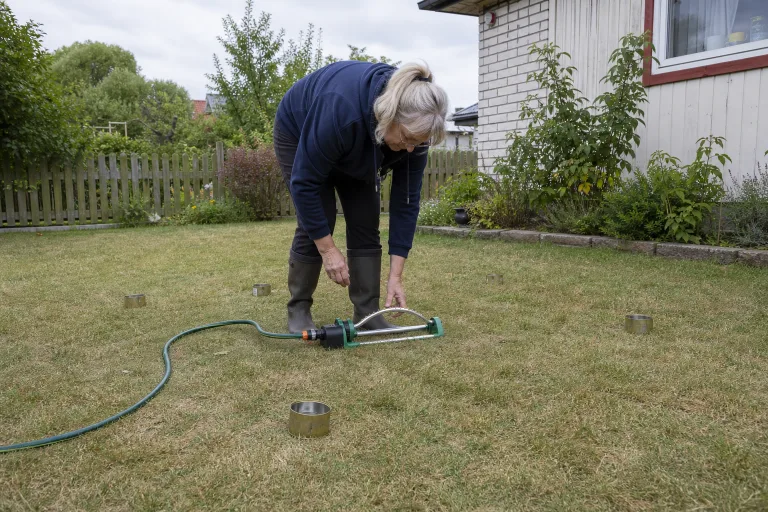
Measure sprinkler output with catch cans
- Place six or more identical straight-sided containers across one irrigation zone, including edges and apparently dry areas.
- Run the zone for a known time, such as 15 minutes.
- Measure the water depth in every container.
- Calculate the average to estimate application depth and compare the values to judge distribution.
- Repeat for each zone; different heads and pressures apply water at different rates.
If some containers catch twice as much as others, increasing runtime will overwater wet spots before dry spots receive enough. Correct blocked nozzles, pressure, spacing, tilt, or mixed head types first.
Distribution uniformity can be estimated with lower-quarter DU: average the lowest quarter of catch-can readings and divide by the overall average. A low result indicates that schedule changes alone cannot create even soil moisture; hardware or layout needs attention.
Convert measured depth into runtime
Suppose the containers average 6 mm (0.24 inch) after 15 minutes. The measured precipitation rate is 24 mm per hour (0.94 inch per hour). If your evidence-based target for that event is 12 mm, the estimated runtime is 30 minutes—unless runoff begins first.
Runtime = target depth ÷ measured depth × test minutesThe target depth should account for rainfall, weather, soil, root depth, water restrictions, and local turf guidance. A rain gauge shows what reached the property; a controller’s “rain delay” does not reveal how much entered the root zone.
On slopes, clay soil, compacted ground, or thatchy turf, use cycle-and-soak: divide the total runtime into shorter cycles separated by enough time for infiltration. If water reaches the gutter, stop. Runoff is lost irrigation, even if the controller is still counting minutes.
Verify depth below the grass
After watering, push a screwdriver into the soil or remove a narrow plug. Note how deep the soil is moist and whether there is a sharp dry boundary. Sandy soil may accept water quickly but store less; clay stores more but may infiltrate slowly. Compaction reduces pore space and can limit both infiltration and roots.
Root depth sets the useful reservoir. If most roots occupy only the top 4 cm, applying enough water for 15 cm of soil does not automatically create deep roots; it may move below the active root zone. Correct mowing, compaction, species adaptation, and oxygen conditions so roots can expand, then adjust irrigation with them.
| Observation | Likely adjustment |
|---|---|
| Water runs off within minutes | Shorter cycles, repair compaction or thatch, reduce application rate |
| Soil is wet but grass wilts | Inspect roots, disease, heat load, and oxygen—not just runtime |
| One strip dries first | Audit head coverage, wind, pavement heat, and soil depth |
| Whole lawn stays soft | Reduce frequency and check drainage or leaks |
Water early enough to reduce loss and leaf wetness
Early morning is often the best compromise: wind and evaporation are usually lower, pressure may be more stable, and leaves can dry after sunrise. Midday irrigation can lose more to wind and evaporation, although brief cooling syringes are a specialized turf practice rather than a normal home-lawn schedule. Evening watering can extend leaf wetness in disease-prone conditions.
Do not irrigate in strong wind, onto frozen soil, or immediately before significant rain. Inspect the system while it runs; leaks and misdirected heads can waste more water than schedule fine-tuning saves.
New seed and dormancy are different systems
New seed needs the upper soil kept consistently moist during germination, often with short light applications. Once seedlings root, reduce frequency gradually and increase depth. Continuing the seed schedule after establishment promotes shallow rooting and disease.
Some established lawns can enter drought dormancy. Dormancy management depends on grass species, duration, heat, local restrictions, and whether you intend to maintain survival irrigation. Repeatedly pushing turf in and out of dormancy can spend stored energy. Decide deliberately and use region-specific guidance rather than watering just enough to create weak intermittent growth.
Calibrate one zone this week
- Run a catch-can test and record every reading.
- Fix obvious distribution problems.
- Calculate application rate.
- Check moisture depth after the next event.
- Subtract effective rain and change runtime seasonally.
Sources and further reading
Replace routine with observation
Hanami brings the same evidence-first approach to plant identification, visible symptoms, and care notes.
Download Hanami